
Listening Figures -

Subscriber Demo

The Subscribers Only functionality is available to RAJAR subscribers who have paid for website access to the RAJAR data. You will require a valid username and password to access this area but you'll only need to enter it the first time you visit (and when you change pc/browser).

For subscription rates please check the How to Subscribe area.

Access across the site is governed as follows:

Open Access

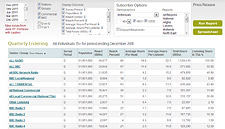
Quarterly Listening

  • Quarter
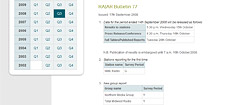
    See data going back to March 1999.
  • Stations / Groups, Commercial / BBC
    Displays results for Groups only, Stations only, or both, for Commercial, BBC or both.
  • Q on Q or Y on Y
    Displays up to 4 consecutive quarters or year on year results, as well as calculate Q on Q and Y on Y change in percent.
  • Display Columns
    Survey Period
    Population (000s)
    Reach (000s)
    Reach%
    Average Hours per Head
    Average Hours per Listener
    Total Hours (000s)

Subscriber Only

Quarterly Listening

  • Display Columns
    Population profile
    Reach index
    Hours index
    Cost Efficiency Factor
  • Demographics
    The following audiences are available for individual stations from Q3 2004:
    Individuals: All / Male / Female / Main Shoppers / Main Shoppers with children
    Age breaks:   4+,  4-14,   4-24,   4-34,   4-44,   4-54,  4-64,   4-74
    15+, 15-24, 15-34, 15-44, 15-54, 15-64, 15-74
    18+, 18-34, 18-44, 18-54, 18-64, 18-74
    25+, 25-34, 25-44, 25-54, 25-64, 25-74
    35+, 35-44, 35-54, 35-64, 35-74
    45+, 45-54, 45-64, 45-74
    55+, 55-64, 55-74
    65+, 65-74
    75+
    Social Grade: All / ABC1 / C2DE
    (42 x 5 x 3 = 630 audience categories)
    There are limited demographics for data prior to Q3 2004 and for groupings such as All Radio, All Commercial and All BBC prior to Q2 2007.
  • Regions
    This option allows you to organise stations by RAJAR regions. Note that station results will be based on their published TSA and not necessarily on the region’s population.
  • Daypart Breakdown
    This option allows you to display Average Audience by Daypart (Breakfast Peak, Mid Morning, Afternoon, PM Drive, Evening, Overnight, see Glossary for full details).

Audiences by daypart

Available when you click on a station name in the Quarterly Listening page. For each station, displays Average Audience with dayparts as columns and demographics as rows.
Click here for an example.

Audiences by period

Available when you click on a station name in the Quarterly Listening page. For each station, choose your columns from the Display Columns box (Population, Reach, Hours etc...) and see results broken down by demographics.
Click here for an example.

Volumes

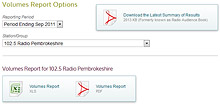
These are standard tables showing results in a pre-formatted way for each participating Commercial Radio station or group, as well as the BBC Networks.

From Q2 2007, tables made available on the website are:
Table 0: Trends data (All Adults)
Table 1: Cumulative weekly audience (reach), total and average hours, by demographics
Table 2: Share by day part segment
Table 3: Reach by day part segment
Table 4: Average half hour audience - Monday-Friday (averaged)
Table 5: Average half hour audience - Saturday
Table 6: Average half hour audience - Sunday
Table 7: Cumulative weekly audience (reach), total and average hours, by competitive stations
Table 8: Share by day part segment, by competitive stations
Table 9: Reach by day part segment, by competitive stations
Table 10: Predicted cumulative audiences (on 1, 2, 3, 4, 8 and 13 weeks)
Click here for an example.

Prior to Q2, the tables available are 1, 4, 5, 6, 7 and 10 only.

Mapping

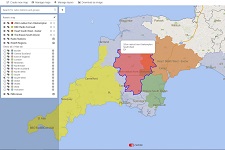
This option allows you to display Total Survey Area for any station on the survey. Up to 5 stations can be displayed on the same map.
Click here for an example.

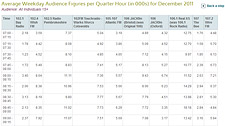
Quarter Hour Chart

This analysis allows you to select published groups or individual stations and displays average audience for each quarter hour for any of the previously mentioned demographic groups.
Click here for an example.

About RAJAR - The Process

An online resource giving very detailed information about how the survey is conducted.